

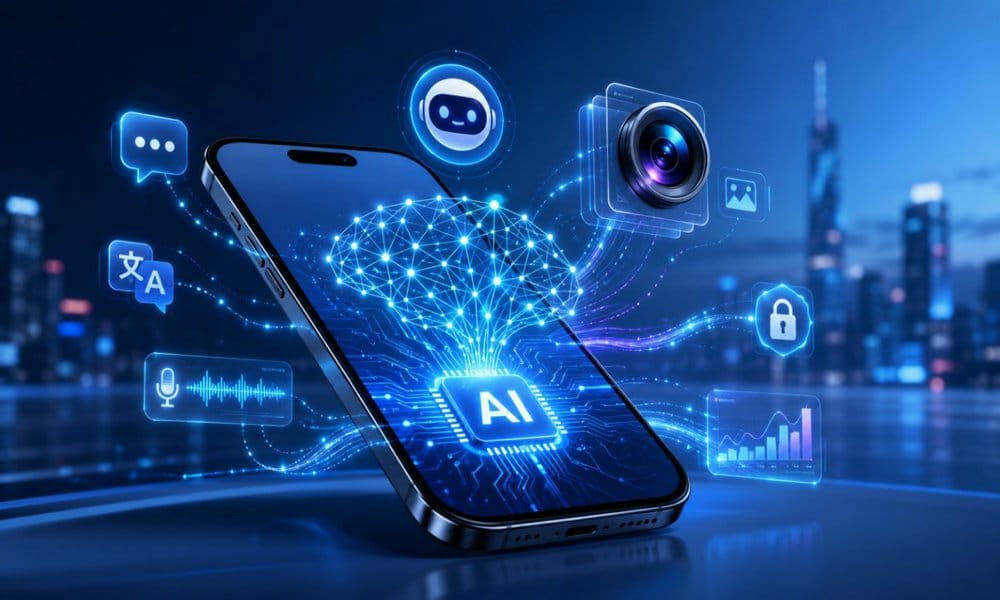
Think about how you use your phone every day. You take photos, send messages, search for places, watch videos, and unlock your phone with your face. Many of these simple actions now use Artificial Intelligence, or AI, in the background. You may not always notice it, but AI is already helping your phone work faster and understand what you need.
AI Smartphones are becoming much more common in 2026. Modern phones can improve photos, translate conversations, suggest replies, organize information, and even help users create new text or images. Companies such as Apple, Samsung, and Google are also adding more AI tools to their phones. Samsung continues to expand Galaxy AI features, while Apple is developing a new generation of Apple Intelligence and Siri AI.
But what actually makes a phone an AI smartphone? How does AI work inside such a small device? And what can it really do for us? In this article, we will explore the history, working process, cameras, voice assistants, security, performance, battery life, and future of AI Smartphones in a very simple way.
What Are AI Smartphones?
AI Smartphones are mobile phones that use Artificial Intelligence to make different features smarter and more useful. AI helps the phone study information, understand patterns, and make better choices. It can help with simple jobs such as choosing the best camera settings or more advanced jobs such as understanding voice commands.
A normal smartphone follows the instructions given by its software. An AI smartphone can go one step further. It can learn from how certain features are used. For example, your phone may notice which apps you open most often. It can then manage power and memory in a way that helps those apps open faster.
This does not mean your phone thinks like a human. AI works by looking at large amounts of information and finding patterns. When your camera knows that you are taking a photo of food, a person, or the sky, it may change the light and colors automatically. That is a simple example of AI working without asking you to change every setting yourself.
Today, AI Smartphones can use AI for cameras, voice assistants, translation, search, security, battery use, writing tools, and much more. This is why AI is becoming an important part of modern mobile phones.
How AI Smartphones Work
The way AI Smartphones work may sound difficult, but the basic idea is simple. AI receives information, studies it, and then uses what it has learned to give a useful result. The information may come from your camera, microphone, apps, sensors, or the way you use your phone.
For example, imagine taking a photo at night. Your phone may capture several images in a very short time. AI can study those images, reduce unwanted noise, improve the light, and combine the best details. You simply press the camera button, but a lot of work happens in the background before you see the final picture.
Modern phones also have special hardware that helps with AI tasks. One important part is called a Neural Processing Unit, or NPU. You can think of an NPU as a part of the phone’s chip that is made to handle AI jobs quickly. It can help the phone process images, understand speech, recognize objects, and run some AI tools without depending completely on an internet server.
There are two common ways AI can work on a smartphone. One is on-device AI, where the work happens directly on the phone. The other is cloud AI, where information is sent to powerful computers online for processing. Some modern systems use both. Apple, for example, says Apple Intelligence uses on-device processing as well as its Private Cloud Compute system for some more demanding tasks.
On-device AI can be useful because it may give faster results and can keep more information on the phone. It can also allow some features to work even when the internet connection is weak or unavailable.
The History of AI in Mobile Phones
AI did not suddenly appear in smartphones. It has been growing for many years. One major moment came in 2011, when Apple launched Siri with the iPhone 4S. Siri helped make voice assistants popular because people could ask questions, set reminders, make calls, and perform other tasks by speaking to their phones.
Voice technology continued to grow. Google introduced Google Now in 2012, while Samsung also offered S Voice on its smartphones. These early assistants were much more limited than today’s systems, but they helped show how phones could become more useful when they understood spoken words and user needs.
Another big change came as phone makers started adding special hardware for AI. Huawei’s Kirin 970, announced in 2017, included a dedicated Neural Processing Unit. Phones also became much better at using AI for photography. Google’s Pixel phones, for example, showed how software and machine learning could improve night photos even when smartphone camera sensors were small.
Over the next few years, Apple, Qualcomm, MediaTek, Samsung, Google, and other companies continued building stronger AI hardware and software. AI started helping with face recognition, photography, translation, speech, battery management, and many other everyday tasks.
Then came generative AI. This gave smartphones new abilities. Instead of only recognizing information, AI could now help create and change it. Phones began offering tools that could rewrite text, summarize information, edit photos, translate speech, and understand more natural questions.
By 2026, AI Smartphones have moved far beyond simple voice assistants. Samsung offers Galaxy AI across supported Galaxy devices, and Apple continues to expand Apple Intelligence with more personal and helpful AI features.
The journey is still continuing. What seemed futuristic only a few years ago is now becoming a normal part of using a smartphone.
AI Smartphones and Smart Cameras
One of the easiest places to see AI working is the smartphone camera. Years ago, getting a good photo often meant changing camera settings yourself. Today, AI Smartphones can handle many of those choices automatically.
Imagine you are taking a picture of your friend outside. The phone can recognize that there is a person in the frame. It may adjust the light on the face, improve the skin tone, keep the sky from becoming too bright, and create a soft background. All of this can happen in seconds.
AI can also recognize different types of scenes. Your camera may know whether you are photographing food, a pet, a building, a sunset, or a person. It can then change things such as brightness, color, focus, and contrast to create a better result.
Better Photos at Night
Low light has always been difficult for small smartphone cameras. AI has helped change that. Modern phones can take several pictures with different levels of light and combine them into one clearer image.
This can make night photos brighter while keeping more detail. AI also helps reduce the small dots and rough areas that often appear in dark photos. The result can look much better than a single normal camera shot.
This technology became well known through features such as Google’s Night Sight. Today, similar ideas are used across many phone brands.
Portraits and Background Blur
AI also helps phones understand the difference between a person and the background. This makes portrait mode possible.
When you take a portrait photo, the phone can keep the person’s face clear while softly blurring the area behind them. This can make a smartphone photo look closer to a picture taken with a larger camera.
AI can also help with hair, glasses, clothes, and the edges around the person’s body. The better the AI becomes, the more natural the result can look.
AI Photo Editing
Photography no longer ends when you press the camera button. Modern AI Smartphones can also help edit the picture afterward.
Some AI tools can remove unwanted objects from photos. Others can move a person or object, improve lighting, fix small problems, or suggest a better crop. Generative AI can even create missing parts of an image in some editing tools.
This means someone with little photo editing experience can make useful changes with only a few taps.
Better Videos
AI is useful for video too. Phones can study movement while you are recording and reduce shaking. This is especially helpful when walking, running, or recording something without a tripod.
AI can also improve focus, lighting, sound, and subject tracking. If you are recording a moving person or pet, the phone can try to keep that subject clear and in focus.
These features show why cameras are one of the strongest examples of how Artificial Intelligence is changing mobile phones.
AI Smartphones and Voice Assistants
Voice assistants were one of the first AI features that many smartphone users noticed. Instead of touching the screen for every task, users could simply speak.
You may say, “Set an alarm for 7 AM,” “Call Mom,” or “What is the weather today?” The assistant listens to your voice, turns the speech into information it can understand, and then tries to complete the task.
Early assistants were useful, but they often needed very clear commands. If you spoke in an unusual way, they could easily become confused. Modern AI systems are becoming much better at understanding normal conversation.
In 2026, voice assistants are moving toward more natural and personal interactions. Apple has announced its next generation of Siri AI for supported devices, while AI assistants on Android phones are also becoming more closely connected with everyday phone tasks. Apple’s new Siri AI is planned as part of its next generation of Apple Intelligence.
Real-Time Translation
AI is also making it easier for people who speak different languages to communicate.
Imagine traveling to another country and receiving a phone call from someone who speaks a language you do not understand. AI translation tools can help translate spoken words during conversations. Similar tools can translate messages and other text.
Apple, for example, has added Live Translation features for supported devices in Messages, Phone, and FaceTime, with some translation work running directly on the device.
This can be useful for travel, work, study, and communication with people around the world.
More Helpful Assistants
The long-term goal is not only to make assistants answer questions. Companies want them to understand what a user is trying to do.
For example, imagine asking your phone, “When does my flight leave?” A smarter assistant may be able to find the related information and give you a useful answer instead of making you search through different apps yourself.
This is one reason AI Smartphones are becoming more useful. AI is slowly changing the phone from a device that waits for every command into one that can offer more useful help during everyday tasks.
AI Smartphones and Better Security
Our phones contain personal photos, messages, emails, payment information, and other private data. Because of this, security is one of the most important parts of a smartphone.
AI Smartphones use AI in several ways to improve security. A common example is facial recognition. The phone studies the shape and features of a face and compares them with stored information before allowing access.
AI can also help fingerprint systems. It may improve how the phone reads and matches fingerprint information, although the exact method depends on the device and the type of sensor being used.
Another useful area is detecting unusual activity. Security systems can look for patterns that may be different from normal use. This may help devices or apps notice possible risks and take action.
AI and Privacy
AI can be very useful, but it also creates important privacy questions. Some AI features need personal information to provide useful results. Users naturally want to know where that information goes and who can access it.
This is why on-device AI has become so important. When an AI task can be completed directly on the phone, some information does not need to be sent to a remote server. This can reduce the amount of personal data that leaves the device.
However, not every AI task can run fully on a phone. Some advanced features may still use cloud systems because they need much more computing power. Good AI systems therefore need to balance usefulness with privacy and security.
As AI Smartphones become smarter, phone makers will need to make these choices clear to users. People should know when AI is being used, what information it needs, and what privacy controls are available.
AI has already changed the way smartphones protect us, understand us, and help us communicate. But security is only one part of the story. AI is also changing how fast phones work, how long their batteries last, and how deeply they can adapt to each user.
AI Smartphones and Better Performance
A smartphone may look simple from the outside, but many things are happening inside it at the same time. Apps are running, messages are arriving, photos are being processed, and the system is using memory and battery power. AI Smartphones can help manage these tasks in a smarter way.
AI can study how you normally use your phone. For example, you may open WhatsApp every morning, YouTube after lunch, and a music app in the evening. Over time, the phone can learn these habits. It may give more power to the apps you use often and reduce activity from apps you rarely open.
This can help the phone feel faster during daily use. Instead of giving the same amount of power to every app, AI can focus resources where they are needed most. It can also help control background tasks that may slow down the phone.
Imagine you are playing a game while several apps are open in the background. An AI system may reduce activity from less important apps so the game can run more smoothly. This does not mean AI can turn a weak phone into a powerful one, but it can help the available hardware work in a smarter way.
Modern AI Smartphones also use special chips for AI tasks. These chips can handle jobs such as image processing, speech recognition, and other AI features without putting all the work on the main processor. This can improve both speed and power use.
How AI Improves Smartphone Battery Life
Battery life is one of the biggest concerns for smartphone users. No one wants to see a 5% battery warning when they are far from a charger. This is another area where AI can help.
AI Smartphones can learn how a person normally uses their device. If there are apps that you rarely open, the phone may limit how often those apps work in the background. This can reduce unnecessary battery use.
AI can also help control screen brightness. Your phone may notice the light around you and adjust the screen automatically. When you are outside in bright sunlight, the screen may become brighter. When you enter a dark room, it may lower the brightness. This can save power while still keeping the screen easy to see.
Some phones also learn charging habits. For example, imagine that you normally charge your phone overnight and unplug it at 7 AM. A smart charging system may manage how quickly the battery reaches a full charge. The goal is to reduce stress on the battery over time.
AI can also help decide when more processing power is needed. Reading a simple message does not require the same amount of power as playing a large game or editing a video. Smart power management can adjust phone performance depending on what you are doing.
Of course, battery life still depends on the size of the battery, screen, processor, network connection, and how heavily the phone is used. AI cannot remove those limits. However, it can help AI Smartphones use their available power more carefully.
AI Smartphones and Personalized Experience
Have you ever noticed that your phone seems to know what you may want to do next? Maybe it suggests an app at the right time, completes a word while you are typing, or shows information that matches your interests. These are examples of personalization.
AI Smartphones can study patterns in the way users interact with their devices. They may learn which apps you use, which words you type often, what time you perform certain tasks, and what types of content you usually choose.
One simple example is predictive text. When you start writing a sentence, AI may suggest the next word. Over time, the suggestions may become more useful because the system understands common language patterns and, depending on the feature, may also learn from the way you write.
Smart replies work in a similar way. If someone sends a simple message such as, “Are you coming today?” your phone may suggest replies like “Yes,” “Not yet,” or “I’ll be there soon.” You can then answer with one tap instead of typing everything yourself.
Personalization can also help with daily routines. Imagine that every weekday you open a maps app before leaving for work. A smart phone may begin showing travel information around that time. It may even warn you about traffic before you leave.
The goal is simple. AI Smartphones try to reduce small tasks and make everyday use easier. At the same time, users should be able to control what information is used for personalization. A useful AI feature should help people without making them feel that they have lost control of their privacy.
Generative AI in Smartphones
Generative AI is one of the biggest changes happening in smartphones. Traditional AI often studies or recognizes information. Generative AI can go further by helping create new text, images, summaries, replies, and other content.
For example, imagine writing a long message to your manager. An AI tool may help shorten it or make it clearer. If you receive a long email, AI may create a short summary so you can understand the main points quickly. These types of tools are becoming an important part of modern AI Smartphones.
Photo editing is another major use. Generative AI can help remove unwanted objects, change parts of an image, improve a photo, or create missing areas after an object has been moved. These jobs once needed advanced editing skills. Today, some of them can be done with only a few taps.
Samsung says its Galaxy AI features are designed to help with communication, creative work, and productivity, with some AI work happening directly on supported Galaxy devices. Apple also announced a new generation of Apple Intelligence in June 2026, with AI features working across apps and using both on-device processing and Private Cloud Compute.
Generative AI can also make search easier. Instead of typing a few exact words, users can ask longer questions in normal language. The AI can try to understand the meaning behind the question and provide a more useful result.
The next step is multimodal AI. This simply means AI that can work with more than one type of information. It may understand text, voice, images, and what is happening on the screen.
Imagine pointing your camera at a plant and asking, “What is this, and how often should I water it?” A more advanced AI assistant could study the image, understand your spoken question, and provide an answer. This shows why generative AI could become one of the most important features of future AI Smartphones.
Benefits and Challenges of AI Smartphones
There are many good reasons why AI is becoming such a major part of mobile technology.
One clear benefit is convenience. AI can reduce the number of steps needed to complete everyday jobs. It can summarize text, improve photos, translate languages, suggest replies, search for information, and help organize tasks.
Photography is another big benefit. People no longer need to understand every camera setting to take a good picture. AI can help manage lighting, focus, colors, night photos, portraits, and editing.
AI Smartphones can also be useful for people with disabilities. Voice control can help users operate phones without touching the screen. Image description tools can help people who have difficulty seeing. Live captions and speech tools can also make communication easier.
AI can improve productivity too. Imagine attending a long meeting. Instead of writing every word yourself, an AI tool may help turn speech into text and create a short summary. A student could use similar tools to organize notes or understand a long document.
However, AI also brings challenges.
Privacy Is Important
Some AI features need access to personal information to work well. This may include photos, messages, voice recordings, or information shown on the screen. This makes privacy very important.
More phone companies are therefore trying to process AI tasks directly on the device when possible. Apple says its 2026 Apple Intelligence system uses on-device processing and Private Cloud Compute for larger requests, with privacy built into the system.
Users should still check their privacy settings. Not every AI feature works in the same way, and some services may need internet access or cloud processing.
AI Can Make Mistakes
AI is helpful, but it is not always correct. An AI assistant may misunderstand a question. A summary may miss an important detail. A photo editing tool may create something that looks strange.
This means users should not blindly trust every AI result. Important information should still be checked, especially when it relates to money, health, work, school, or other serious decisions.
AI Features May Cost More
Powerful AI needs strong hardware. More advanced processors, memory, and other parts can increase the cost of a smartphone.
Some of the newest AI tools may also be limited to more expensive phones. Other features may need an online service or paid plan. This can create a difference between users who have premium phones and those who use cheaper devices.
However, technology usually becomes cheaper with time. Features that first appear on expensive phones often reach more affordable models later. We are already seeing AI features spread across a wider range of devices.
So, AI Smartphones offer many useful benefits, but they are not perfect. The best experience comes when AI is helpful, clear, secure, and under the user’s control.
The Future of AI Smartphones
The future of AI Smartphones may be very different from the phones we use today. AI is moving from simple tools hidden inside apps toward a system that can help across the whole phone.
One major change will be smarter AI assistants. Today’s assistants can already answer questions and complete some tasks. Future assistants may better understand personal context, what is on the screen, and what the user is trying to achieve.
Apple previewed a new Siri AI system in June 2026 that can use personal context and work across messages, emails, photos, apps, and information on the screen on supported devices. The new features are planned to roll out with Apple’s next software generation.
This gives us an idea of where the smartphone industry is heading.
Imagine saying, “Find the hotel my friend sent me last week and tell me how far it is from the airport.” Instead of opening several apps and searching through old messages, a future AI assistant may be able to help with the whole task.
More AI Will Work on the Phone
On-device AI is also likely to become more powerful. As smartphone chips improve, phones will be able to perform more AI tasks without sending everything to online servers.
This can make AI Smartphones faster and more useful when the internet is slow. It may also help keep more personal information on the device.
Cloud AI will still be useful for very large jobs. The future will probably use a mix of both systems. Smaller and more personal tasks may happen on the phone, while more demanding tasks may use secure online systems.
Phones May Understand More Than Words
Future AI will not only understand text. It will increasingly work with voice, photos, videos, sounds, and information shown on the screen.
Imagine seeing a broken part on your bicycle. You could point your phone camera at it and ask what may be wrong. AI could study the image and explain what it sees.
Or imagine traveling abroad. Your AI Smartphone could listen to another language, translate it for you, understand signs through the camera, and help you reply.
These examples show how smartphones could become much more useful in real-life situations.
AI May Become More Proactive
Most phones today wait for you to ask for help. In the future, AI may become more proactive.
For example, your phone may know that you have a flight tomorrow. It could remind you when to leave, show your boarding information, warn you about traffic, and tell you if the flight time changes.
The important part will be control. Users should be able to decide how much help they want. A smartphone that constantly acts without permission could quickly become annoying.
The best future AI Smartphones will likely be the ones that understand when to help and when to stay quiet.
AI Will Reach More Affordable Phones
Advanced AI features often appear first in flagship phones because those devices have the strongest chips and more memory. But this is unlikely to remain limited to expensive models forever.
As AI hardware becomes more common, more features should reach mid-range and lower-cost phones. This could make tools such as smart translation, better cameras, voice assistance, and AI editing available to millions more people.
That may be one of the biggest changes in the coming years. AI will not simply be a special feature used to sell premium phones. It could become a normal part of almost every smartphone.
Conclusion
AI Smartphones have changed the meaning of a mobile phone. A phone is no longer only a device for calls, messages, and internet browsing. Artificial Intelligence now helps smartphones take better photos, understand voices, translate languages, improve security, manage power, and offer more personal experiences.
The biggest change is that AI is becoming easier to use. You do not need to understand complicated technology to benefit from it. When your phone brightens a dark photo, suggests a useful reply, removes an unwanted object from an image, or helps you find information, AI is doing much of the work in the background.
Generative AI is pushing this change even further. Modern AI Smartphones are starting to create content, summarize information, understand images, and help users complete tasks across different apps. In 2026, companies such as Apple, Samsung, and Google continue to build AI more deeply into the smartphone experience.
There are still questions about privacy, accuracy, cost, and how much access AI should have to personal information. These issues will become even more important as phones become smarter.
Still, one thing is clear. Artificial Intelligence is becoming a major part of the future of mobile technology. The next generation of AI Smartphones will likely understand more, respond faster, and offer more useful help in everyday life.
The smartphone in your pocket is already much smarter than the phones people used only a few years ago. And if AI continues developing at its current pace, the most interesting changes may still be ahead.
(FAQs)
What is an AI smartphone?
An AI smartphone is a mobile phone that uses Artificial Intelligence to make different features smarter and easier to use. AI can help improve photos, understand voice commands, manage battery life, suggest replies, translate languages, improve security, and learn how a person normally uses the phone.
How does AI work in smartphones?
AI works by studying information from the phone, such as camera images, voice, apps, sensors, and user actions. It finds patterns and uses them to give better results. Some AI tasks happen directly on the phone, while other tasks may use cloud servers through an internet connection.
What are the main features of AI smartphones?
AI smartphones can include smart cameras, voice assistants, live translation, face recognition, smart battery control, photo editing, text summaries, predictive typing, smart search, and personalized suggestions. The exact features depend on the phone model and the software it uses.
How does AI improve smartphone cameras?
AI helps smartphone cameras recognize people, food, pets, buildings, and other scenes. It can automatically improve brightness, colors, focus, and contrast. AI can also help with night photos, portrait mode, background blur, video stabilization, and removing unwanted objects from pictures.
Do AI smartphones work without the internet?
Some AI features can work without the internet because the processing happens directly on the phone. These are called on-device AI features. However, more advanced tasks may still need an internet connection because they use powerful cloud servers to process information.
Are AI smartphones safe to use?
AI smartphones can be safe when users follow normal security steps and use trusted apps and services. Many phones use AI for face recognition, fraud detection, and security checks. However, users should still review privacy settings because some AI features may need access to photos, messages, voice, or other personal information.
Can AI help improve smartphone battery life?
Yes, AI can help manage battery use by learning how you use your phone. It may limit apps that you rarely open, control background activity, adjust screen brightness, and manage power based on the task you are doing. This can help the battery last longer during normal daily use.
What is generative AI in smartphones?
Generative AI is a type of AI that can create or change content. On smartphones, it can help write messages, summarize text, edit photos, remove objects from images, translate conversations, and answer questions in a more natural way. These features are becoming more common in modern AI smartphones.
What are the disadvantages of AI smartphones?
AI smartphones can have some disadvantages, including privacy concerns, incorrect AI answers, higher phone prices, and extra battery or memory use for some features. AI can also make mistakes, so users should always check important information instead of trusting every AI result without question.
What is the future of AI smartphones?
The future of AI smartphones will likely include smarter voice assistants, better on-device AI, stronger privacy, faster translation, advanced photo editing, and more personal help. Future phones may understand text, voice, images, and videos together and may also help users complete tasks before they even need to open several apps.
